This article is designed for individuals whose primary goal is to build muscle and strength while training 5 or more days per week, typically in a gym environment. Training at this frequency is the territory of dedicated lifters, advanced trainees, or people whose lifestyle genuinely accommodates daily gym time. The rules are different at this volume — and the margin for error is much smaller.
When training frequency is high, the priority shifts to managing recovery and avoiding accumulated fatigue. The stimulus side of the equation is rarely the problem at 5+ sessions per week. The problem is whether your body can absorb that stimulus and turn it into growth, or whether the volume becomes junk volume that just makes you tired.
The biggest mistake people make at this frequency is assuming more is always better. It’s not. Past a certain point, additional sessions don’t add muscle — they just add fatigue, joint stress, and the risk of breaking down. The lifters who succeed at 5+ days per week are the ones who treat recovery as seriously as training.
Who Should Actually Train 5+ Days Per Week
Let’s be honest about who this frequency is for. It’s not for most people. It’s appropriate if:
- You’ve been training consistently for at least 2–3 years
- You can sleep 8+ hours per night without exception
- You’re eating enough — most likely 3,000+ calories per day depending on bodyweight
- Your job and life genuinely accommodate daily training
- You manage stress well outside the gym
- You have no significant joint issues or chronic injuries
If most of those don’t apply, you’re probably better served by 3–4 days per week with higher quality. Adding sessions to compensate for poor execution is one of the most common mistakes in fitness.
That said, if you do meet the criteria, 5–6 days per week can deliver excellent results — particularly for advanced lifters who’ve maxed out what they can do in 4 sessions and need to spread volume out to keep each session productive.
The Logic of High-Frequency Training
At 5+ days per week, the goal is rarely to do more total work than you’d do in 4 days. The goal is to spread similar volume across more sessions so each session is shorter, fresher, and more productive.
A lifter doing 16 sets of chest in 2 sessions per week (8 sets each) often performs better than the same lifter doing 16 sets in 1 session. This is because the last 4–6 sets of any session are usually performed under accumulated fatigue, with worse technique and lower output. Spreading volume increases the percentage of “high-quality” sets in your week.
This is why the most evidence-based high-frequency approach is Push/Pull/Legs run twice per week (PPL x2) — 6 sessions per week, each muscle group hit twice, sessions stay around 60 minutes. It’s the gold standard for advanced natural lifters who train this often.
Recommended Routine: 6-Day Push/Pull/Legs Twice Per Week
This is the structure used by serious lifters at this frequency. Six training days, one full rest day. Each muscle group is hit twice per week with focused volume in each session.
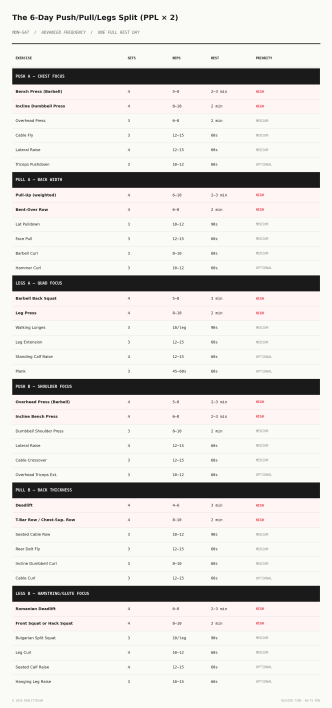
Session length: 60–75 minutes, including warm-up. Sessions running consistently over 90 minutes mean you need to either cut accessories or extend rest periods less.
Volume Targets: Where the Real Risk Lives
At this frequency, weekly volume creeps up fast. Stay aware of these maximums — going beyond them rarely produces more growth, but reliably produces more fatigue and injury risk:
- Chest: 12–20 sets per week (above 20, you’re likely producing junk volume)
- Back: 14–22 sets per week
- Quads: 12–20 sets per week
- Hamstrings: 10–16 sets per week
- Shoulders: 14–22 sets per week (all heads combined)
- Arms: 8–16 sets direct work per week (compounds add indirect volume)
If you’re hitting the top of these ranges and not progressing, the answer is not more volume. The answer is better recovery, better food intake, or a deload. This is the most important principle at high frequency.
Recovery Becomes Non-Negotiable
At 1–4 days per week, recovery is important. At 5+ days per week, recovery is the entire game. You can’t outwork bad recovery. You also can’t compensate for poor sleep with extra training. Both of those approaches lead to the same place: regression and injury.
The non-negotiables at this frequency:
- Sleep 8+ hours per night, every night. Not “I’ll catch up on weekends.” Every night.
- Eat in a calorie surplus if your goal is muscle gain. For most lifters at this frequency, that’s 2,800–3,500+ calories per day depending on size.
- Protein intake of 1.8–2.2g per kg of bodyweight. This is the upper end of useful intake.
- Manage stress aggressively. Chronic stress at this volume will break you faster than any training mistake.
- Take a deload week every 4–6 weeks. Not every 8–10 weeks like at lower frequencies. The accumulated fatigue is higher.
- One full rest day per week, minimum. No “active recovery cardio sessions” that turn into 45-minute runs.
The lifters who fail at 5+ days per week almost always fail on the recovery side, not the training side. They train hard. They just don’t recover hard enough.
How to Progress at High Frequency
Progression at 5+ days per week is slower per session but faster per week than at lower frequencies. Don’t expect to add weight every session — expect to add weight every 1–2 weeks on most lifts.
The model that works best:
- Week 1–3: progressive overload phase, adding reps or weight each week
- Week 4: deload week (50% volume, 70% of normal weights)
- Week 5–7: new overload phase from a slightly higher baseline
- Week 8: deload week again
This 7-on / 1-off pattern (or 6-on / 2-off depending on the lifter) is the only sustainable way to run high-frequency training long-term. Skipping deloads at this volume is a guaranteed path to injury or stagnation.
Track every session. Without tracking, you’ll plateau and not realize it for weeks. At this frequency, blind training is the enemy of progress.
Realistic Expectations: What 5+ Days Per Week Actually Delivers
Here’s the uncomfortable truth: for most people past the first 2 years of training, the difference in muscle gain between 4 days and 6 days per week is small. Often less than 0.5 kg per year of additional gain. You’re putting in 50% more time for marginal returns.
That said, advanced lifters who’ve genuinely plateaued at 4 days per week often see meaningful renewed progress when moving to 5–6 days. The key word is plateaued — if you’re still progressing at 4 days, there’s no reason to add sessions.
Realistic gains at this frequency for an advanced natural lifter:
- Year 3 of training: 1–3 kg of muscle per year
- Year 5+: under 1 kg per year, even with optimal everything
- Strength gains: 5–15 kg added to major lifts per year, depending on which lift and starting point
These numbers are for natural lifters. Almost everyone showcasing dramatic year-over-year transformation at the advanced level is using performance-enhancing compounds. Don’t benchmark your progress against people whose results require pharmaceuticals to achieve.
Common Mistakes at This Frequency
- Skipping deloads. This is the #1 mistake. Deloads aren’t optional, they’re a structural part of the program.
- Adding sessions when progress slows. The fix is almost always better recovery, not more training.
- Treating cardio as additional volume. If you’re doing 6 lifting sessions plus 4 cardio sessions, you’re under-recovered. Period.
- Underrating sleep. Six hours of sleep at this volume is the same as deliberate sabotage.
- Eating like a 4-day lifter. Your calorie needs are noticeably higher. Adjust them or pay the price.
- Ego-lifting. Form breakdown at this volume produces injuries that take you out for months. Leave 1–2 reps in the tank on most sets.
- Not having a deload protocol. “I’ll deload when I feel like it” is not a protocol. Schedule them in advance.
When to Drop Back to 4 Days Per Week
There’s no shame in reducing frequency when life or recovery demands it. Signals that you should drop to 4 days per week:
- Strength is dropping for 2+ weeks despite proper food and sleep
- Joint pain in 2+ areas that doesn’t resolve with a deload
- Sleep quality is consistently poor and you can’t fix it
- Life stress (work, family, relationships) has spiked
- You’re losing motivation and dreading sessions
Reducing frequency for a training block is a strategic decision, not a failure. The lifters who train productively for 10+ years know how to scale up and down based on life context. They don’t try to maintain 6 days per week through divorce, job changes, or new babies.
Final Word
Training 5+ days per week can deliver outstanding results for the right lifter at the right time. It’s a tool, not a default. If you’ve earned it through years of consistent training, recovered properly, and have the lifestyle bandwidth to sustain it, this frequency can take you places lower frequencies can’t.
But if you’re using high frequency to compensate for poor execution, lack of intensity, or impatience with results — you’re going to break before you grow.
Train smart. Recover harder. Track everything. Take deloads like they’re sacred. Do this for years, not months, and you’ll build a body that’s both impressive and durable.
Fitness works best when it supports your life, not when it competes with it. At 5+ days per week, the line between supporting and competing is thinner. Respect it.