
This article is designed for individuals whose primary goal is to build muscle and strength while training only 1 to 2 days per week, typically in a gym environment. Fitness success doesn’t depend on how often you train — it depends on aligning your expectations with your real lifestyle, recovery capacity, and long-term consistency.
When training frequency is low, the priority shifts dramatically. You can’t afford to waste a session on isolation movements that move the needle by 1%. Every minute in the gym needs to deliver compound stimulus, hit multiple muscle groups at once, and fit into a recovery window that lasts most of the week.
The biggest mistake people make at this frequency is trying to replicate a 5-day bodybuilding split into 2 sessions. It doesn’t work. The math doesn’t add up. Instead, the model that delivers real results at 1–2 days per week is full-body training with heavy compound lifts, executed with intent and tracked over time.
Why 1–2 Days Per Week Can Still Build Muscle
There’s a persistent myth that you need 4 to 6 sessions per week to see results. The science says otherwise. Research on training frequency consistently shows that total weekly volume matters more than how that volume is distributed. If you can hit 10–15 hard sets per muscle group per week — even spread across just two sessions — you’ll grow.
The catch is intensity and execution. At low frequency, you have zero room for junk volume. Every set must be close to failure, every rep must be controlled, and every session must be planned in advance. There is no “I’ll figure it out at the gym” at this frequency.
The advantage of training only 1–2 days per week is that recovery is almost never the bottleneck. You’re not fighting accumulated fatigue, joint stress, or central nervous system burnout. This means you can push harder in each session and still come back fresh next time.
The Core Principle: Full-Body, Compound-First
At this frequency, isolation exercises are a luxury you can’t afford. Every session should be built around the major compound movements:
- Squat (or a heavy leg press variation)
- Deadlift (conventional, Romanian, or trap bar)
- Bench press (barbell or dumbbell)
- Overhead press (standing or seated)
- Pull-up or row (heavy back work)
These five movement patterns hit nearly every muscle in your body. One set of heavy squats does more for your legs than ten sets of leg extensions. This is non-negotiable at low frequency.
Recommended Routine: 2 Days Per Week
The structure below is built for someone training Monday and Thursday, or any two days separated by 2–3 days of recovery. If you can only train once per week, do Workout A every session and progress weight slowly.
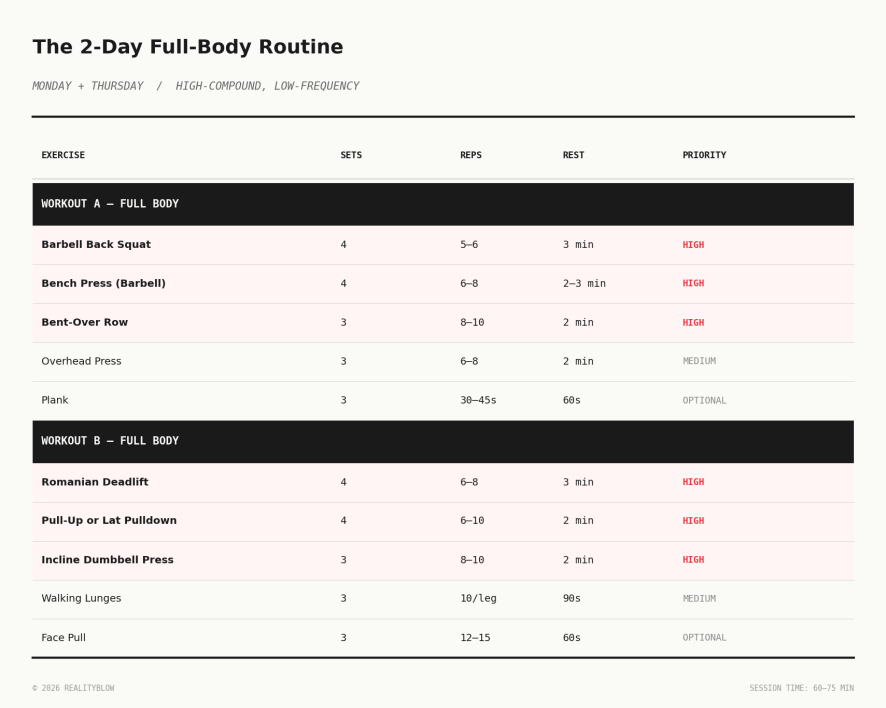
Total session time: 60–75 minutes, including warm-up. If you’re spending more than 90 minutes, you’re either resting too long between sets or doing too much.
How to Progress: The Only Rule That Matters
Add weight or add reps every single session. That’s progressive overload, and at this frequency it’s the only thing that drives results. Track your lifts in a notebook or app. If last week you did 4×6 at 80kg on the bench, this week you do 4×6 at 82.5kg, or 4×7 at 80kg. No tracking, no progress.
When you can’t add weight or reps for two sessions in a row on a specific lift, deload that lift by 10% and build back up. This is normal and expected. Plateaus are part of the process.
Recovery Is Where the Magic Happens
Training 1–2 days per week sounds easy, but the recovery requirements are still real. Muscle growth happens between sessions, not during them. Three things matter most:
- Sleep: 7–9 hours per night, non-negotiable. Sleep deprivation kills strength gains faster than any bad program.
- Protein intake: aim for 1.6–2.2g of protein per kilogram of bodyweight per day. Spread across 3–4 meals.
- Active recovery: walking, light cycling, or mobility work on off-days. Sitting on the couch all week between sessions is not recovery, it’s stagnation.
You don’t need supplements to make this work. Whole foods, sleep, and consistency outperform any pre-workout or fat burner on the market.
Realistic Expectations: What 1–2 Days Per Week Actually Delivers
Here’s the honest truth most fitness content avoids: you will build muscle slower than someone training 4 days per week. That’s just biology. But you’ll also recover better, get injured less, and stay consistent for years instead of burning out in 6 months.
A reasonable expectation is 1–2 kg of lean muscle gain per year if you’re past the beginner phase, eating enough protein, and training with real intensity. If you’re a beginner, you can expect double that in your first year. This is what’s called “newbie gains” and it disappears after 12–18 months.
Strength gains will be more dramatic than visual changes, especially in the first six months. You’ll add weight to the bar every week. Your body will look different in 6 months, noticeably different in 12, and significantly different in 24.
The Mindset Shift: Training Has to Fit Your Life
The reason most people fail at fitness isn’t lack of motivation. It’s lack of alignment. They pick programs designed for people whose entire life revolves around the gym, then wonder why they can’t sustain it.
Training 1–2 days per week is not a compromise. It’s a strategy. It’s the strategy that works for people with demanding careers, families, social lives, or simply other priorities. The goal is to make fitness a permanent part of your life — not a temporary obsession that ends in burnout.
Consistency over 5 years at 2 days per week beats consistency over 6 months at 5 days per week. Always.
Common Mistakes to Avoid
- Skipping the compound lifts because they’re hard. The hard lifts are the ones that work.
- Adding random isolation exercises to “feel like you trained more”. You didn’t, you just got tired.
- Not tracking your progress. If you don’t know what you lifted last week, you’re not training, you’re exercising.
- Eating too little protein. Most people eat half of what they need. Weigh your food for one week to see the truth.
- Comparing yourself to people training 5 days per week. Different game, different rules.
Final Word
Training 1–2 days per week with the right structure can build a body you’re proud of. The barrier isn’t time, it’s execution. Show up, lift heavy, eat enough, sleep well, and repeat for two years. The results will be obvious — both to you and to everyone around you.
Fitness works best when it supports your life, not when it competes with it. At 1–2 days per week, you’re not behind. You’re sustainable. And sustainable always wins.