
This article is designed for individuals whose primary goal is to build muscle and strength while training 3 to 4 days per week, typically in a gym setting. This is widely considered the sweet spot for hypertrophy and strength development — enough frequency to drive consistent progress, but with enough recovery built in to avoid burnout and overuse injuries.
When training frequency is moderate, the priority becomes sustainable progress through structured volume. Rather than chasing aggressive routines, effective programs at this level focus on quality movement, proper recovery, and gradual overload. This approach reduces injury risk and supports long-term adherence — which is what actually builds bodies, not 8-week extreme programs.
The biggest opportunity at 3–4 days per week is the ability to split your training intelligently. You can hit each muscle group twice per week, train with real intensity on every session, and still recover properly between workouts. This is the frequency where most natural lifters see their best results.
Why 3–4 Days Per Week Is the Optimal Range
Research on training frequency is consistent: for most natural lifters, hitting each muscle group 2 times per week produces better hypertrophy than hitting it once. Going beyond that — to 3 or 4 sessions per muscle group per week — only helps if total volume is high and recovery is dialed in. For 95% of people, 3–4 sessions per week is the maximum useful frequency.
The advantage of this range is that you can run real splits. Upper/Lower, Push/Pull/Legs, or even an intelligent full-body program. You’re not forced into “everything in one session” mode like at 1–2 days per week, but you also haven’t hit the diminishing returns of 5+ days.
There’s also a psychological factor worth mentioning. Training 3–4 days per week leaves room for life. Family dinners, social events, work travel, weekends away — none of this derails you. A program you can sustain for years beats a program that breaks after 8 weeks. Always.
The Two Best Splits at This Frequency
There are dozens of ways to structure 3–4 days per week, but only two splits consistently deliver results for natural lifters: Upper/Lower and Push/Pull/Legs (PPL).
Upper/Lower (4 days) is ideal if you want maximum frequency on each muscle group with manageable session length. You hit upper body twice and lower body twice per week.
Push/Pull/Legs (3 days, rotating to 6 in advanced cases) is ideal if you prefer training each muscle group with focused volume in one session. At 3 days per week, you hit each muscle once per week — which works but is suboptimal. Most lifters at 3 days do better with full-body or upper/lower variations.
For the recommended routine below, we’ll use a 4-day Upper/Lower split, which is the most evidence-based structure at this frequency.
Recommended Routine: 4-Day Upper/Lower Split
This routine is built around two upper body sessions and two lower body sessions per week, with at least one rest day between same-muscle sessions. A typical week looks like Monday/Tuesday/Thursday/Friday, leaving Wednesday and the weekend free.
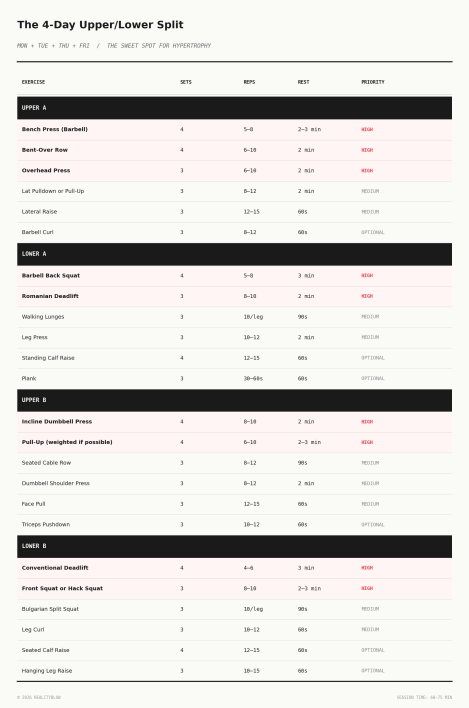
Session length: 60–75 minutes, including warm-up. If sessions are running over 90 minutes, you’re resting too long between sets — not training harder.
Volume Targets That Actually Drive Growth
The reason this split works is the weekly volume per muscle group. Total hard sets per week should land in these ranges for optimal hypertrophy:
- Chest: 10–16 sets per week
- Back: 12–18 sets per week
- Quads: 10–16 sets per week
- Hamstrings: 8–12 sets per week
- Shoulders: 12–18 sets per week (counting all heads)
- Arms: 6–12 sets direct work per week (arms also get indirect work from compounds)
More volume isn’t better past a point. If you’re already hitting these numbers and still progressing, stay there. If you stop progressing, add 2–3 sets per week and reassess in 4 weeks.
How to Progress: The Engine of Results
Progressive overload at 3–4 days per week looks like this:
- Week 1: Bench Press 4×6 at 80kg
- Week 2: Bench Press 4×7 at 80kg
- Week 3: Bench Press 4×8 at 80kg
- Week 4: Bench Press 4×6 at 82.5kg (and the cycle restarts)
This is called double progression — first you add reps, then you add weight. It’s the simplest and most reliable way to progress for the majority of lifters. Track every session. If it’s not written down, it didn’t happen.
Every 6–8 weeks, take a deload week where you reduce all weights by 30–40% and cut volume in half. This isn’t optional. It’s how you avoid the plateaus, injuries, and burnout that derail most lifters around month 4 or 5.
Recovery: The Silent Multiplier
At 3–4 days per week, recovery is the variable that separates good lifters from great ones. The training stimulus is similar across thousands of programs. What’s different is how people recover:
- Sleep 7–9 hours per night. This is the single most important recovery variable. More than supplements, more than stretching, more than ice baths.
- Protein intake of 1.6–2.2g per kg of bodyweight daily. Most people eat half of this. Weigh your food for a week to find out where you actually are.
- Total calorie intake at maintenance or slight surplus if you’re trying to build muscle. You can’t grow on a deficit unless you’re a complete beginner.
- Active recovery on off-days: walks, light mobility work, low-intensity cycling. Sitting motionless doesn’t accelerate recovery — it slows it.
- Stress management: chronic high cortisol from work or life stress directly impairs muscle growth. This is real, not a wellness influencer myth.
You don’t need ice baths, infrared saunas, or $200/month supplements. The basics, applied consistently, beat every advanced strategy.
Realistic Expectations: What 3–4 Days Per Week Actually Delivers
For a natural lifter past the beginner stage, training 3–4 days per week with real intensity, eating enough protein, and sleeping properly:
- First 12 months (beginner): 6–10 kg of lean muscle gain is achievable
- Year 2: 3–5 kg of additional muscle
- Year 3+: 1–3 kg per year, with diminishing returns
Strength gains will outpace visual changes for the first 6 months, then visual changes start to become obvious. By month 12 you’ll look noticeably different. By month 24 you’ll be unrecognizable to people who haven’t seen you in two years.
These numbers assume you’re not on performance-enhancing drugs. Most fitness content online is from enhanced lifters who downplay or hide it. Don’t compare your year 3 progress to someone whose physique requires pharmaceuticals to maintain.
Common Mistakes at This Frequency
- Adding too many isolation exercises. Compounds first, always. Isolations are accessories, not the main course.
- Switching programs every 4–6 weeks because progress isn’t dramatic enough. Programs need 12–16 weeks to be properly evaluated.
- Going to failure on every set. Stay 1–3 reps shy of failure on most sets. Failure is a tool, not the default.
- Skipping leg days because they’re hard. Asymmetric development is both ugly and bad for long-term joint health.
- Doing cardio in a way that interferes with recovery. If you’re trying to build muscle, keep cardio to 2–3 sessions of 20–30 minutes per week, separated from lifting if possible.
- Not eating enough. “Eating clean” with 1,800 calories when you need 2,800 is why you’re not growing.
When to Adjust: Signals to Watch
Your body will tell you when something needs to change. Listen to these signals:
- Strength stagnates for 3+ weeks despite proper sleep and food → consider a deload, not more volume
- Joint pain that doesn’t go away within 2 sessions → reduce load, change exercise variation
- Sleep quality drops, mood drops, motivation tanks → you’re under-recovered, take 5–7 days light
- Constant soreness that doesn’t fade by the next session → too much volume or too little food
These aren’t excuses to skip workouts. They’re data. Adjust the program, then keep training.
Final Word
Training 3–4 days per week is the optimal range for most people building muscle and strength naturally. It delivers results without consuming your life. It builds a body that lasts, not a body that breaks down at 35 from accumulated junk volume.
Show up four times a week. Lift heavy on the compounds. Track your progress. Eat enough protein. Sleep enough. Do this for two years and the transformation will be undeniable.
Fitness works best when it supports your life, not when it competes with it. 3–4 days per week is the frequency that fits.